Posts

Showing posts with the label Austrian Economics

How To Get Rid of Lobbyists
Image
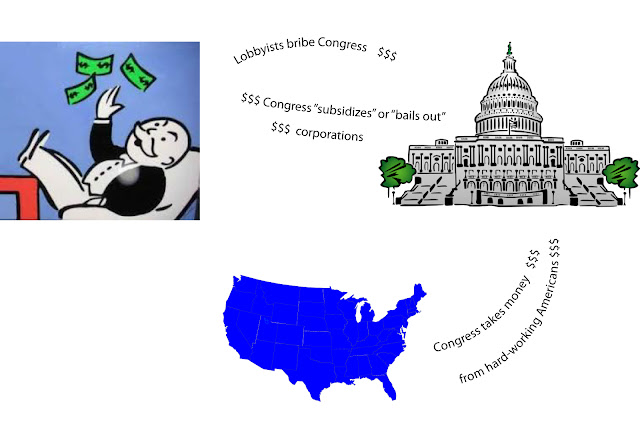
Jack Abramoff recently gave an interview on how he had bribed at least 100 congressional offices .  He said that those numbers were pretty low when it comes to lobbying. Michael Moore entertainingly depicted the revolving doors between Goldman Sachs and Congress.  But like many on the left, he doesn't grasp that the problem isn't that the power of government can be bought and sold.  The problem is that government has power at all. Governmental power is greater than that of any corporation or individual.  Government can take money it has not earned.  No other entity can legitimately do that. The big banks that received the bailouts, received them from the government.  On their own, banks have to get their money from people who voluntarily give it to them.  But not if they lobby Congress. Notice that once lobbyists get some tax money, they can use our taxes to bribe Congress.  Congressmen and crony corporations use the revolving door of lobbying to ...

Non-Aggression Principle Cartoon

Image
I finished a couple episodes of the cartoon I've been working on:

Rothbard on the Beach

Image
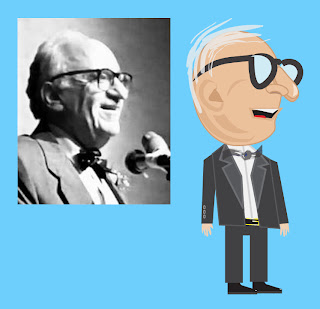
I'm working on a Murray Rothbard cartoon.  Here's where I'm at:

Tu ne cede malis sed contra audentior ito

Image
In honor of Ludwig von Mises . For liberty .

Classic bad economic thought by Krugman

Image
From the Mises Blog

Money isn't magic unicorn piss

Image
Jack Balkin, A Yale law professor,  suggested that the Treasury mint two $1,000,000,000,000 coins , and toss those coins at the national debt to make it go away. Apparently you can believe  King Midas  exists and still teach at Yale. All of us want money, but most of us don't understand how it works. Money is basically an IOU.  It is evidence that you have done something for someone.  If you have it, it proves that you are a helpful member of society.  And you can pass it on to other people who do something for you. You can't give something you don't have. Most of us get money every two weeks in the form of a paycheck.  It is proof that we have worked forty hours a week for our employer.  It's a certificate of performance . How did your employer get that money?  The same way you did.  He traded goods or services with someone else, in exchange for these certificates of performance. If we keep tracing money to its source, we find a...

Rain Man: The Pagan Origins of Modern Politics

Image
People used to expect their rulers to make it rain. When the majority of people used to farm, crop failure meant economic devastation on top of starvation.  As Lord Raglan put it: " A good king is one whose subjects prosper, whether he himself is virtuous and kindly or not. This applies much more fully in the case of a king whose duties are purely ritual. Just as the good rain-maker is the one who induces good rain, so the good king is the king who induces good crops, good hunting, and so on ." Now that most of us do not farm, we want our rulers to “make it rain” economically. But the belief that  prosperity can be legislated is just as backward as believing a king can change the weather. Wealth is created through work and exchange. Government cannot create wealth . Whatever money it has, it has either borrowed, begged, or stolen. Forcible transfers of wealth from one person to another do not create more wealth. Fed Chairman Bernanke, just resting his head. Eve...

The minimum wage hurts poor people

Image
Walter E. Williams discusses a new study on how the minimum wage hurts poor minorities. See: How welfare hurts poor people .

Welfare hurts poor people (and the rich)

Image
We should give to the poor.  But must we? I win! (Edited by Double Birds) In a voluntary exchange both parties benefit .  A rich man may give money to the poor, and the poor may give nothing in return, but the rich man still gets something.  He may get to feel good about himself. He may, if religious, get a feeling that he has laid up treasure in heaven.  He may simply get satisfaction out of the poor man's smile, or knowing that he has made the poor man's life better.  He may get public recognition—entire hospitals and colleges have been built for this seemingly trivial benefit. Voluntary exchanges always  benefit both parties, otherwise they would not occur.  Forced charity, on the other hand, hurts both parties. If the rich man's money is forcibly taken (through taxation), he gets nothing.  No recognition.  No smiling poor.  He might not even want outward recognition, but he does not even know where his money goes.  He may ki...

Using gang violence to end gang violence

Image
Thuggish police beat, tased, and broke the arm of a student for wearing baggy pants .  It was in an effort to rid the school of its "gang culture." Who's gangsta now? This is what happens when you give a guy a gun, a taser, and bat; immunity from the law; and tell him to go enforce the law. Since the police force is a government monopoly, it has been removed from market forces.  There is no feedback mechanism to tell them whether they're serving the customer or not. Monopoly is why government services (think DMV) suck.  If Costco were to tase customers who wore baggy pants, they would lose customers, get sued, and probably go out of business.  If a police officer abuses customers, our taxes still pay them. People tend to scoff at the idea of breaking up police monopoly.  The main argument I've heard: Q: In a free market, wouldn't only rich people would have police? A: In our free market, poor people have access to almost every good imaginable (for example—p...

Why gas prices rise

Image
With headlines like " Obama knows political fortunes tied to gas prices " it's clear we're going to hear a lot of nasty things about oil speculators this political season. Politicians (known for their honesty and good character) blame speculators for the rise in gas prices.  This cringe-inducing lie is wrong for two reasons: 1. Speculators alleviate  gas crises. 2. It's the effin politicians who are responsible for rising gas problems, and ensuing gas shortages. Speculators Here's a chart of gas prices, to explain how speculators help us out at the pump: Chart (modified) from this excellent article . When prices are low, speculators buy, when prices rise, speculators sell.  This is how money is made on the stock market.  The overall effect is to even out turbulence in prices.  Selling when prices are high floods the market with oil, causing the price to fall.  If prices dip down, speculators buy up oil shares, limiting supply, which causes oil prices to...

Keynes vs. Hayek

The best way to learn traditional econ. and Austrian econ. Keynes represents popular econ .  Hayek (the bald one) represents Austrian econ. See part 1 .